We have a serious weight issue in the United States.
72% of U.S. adults are overweight, 41% meet obesity criteria, 14% have diabetes, and 43% have prediabetes, which emerging evidence suggests has its own set of clinical effects. And it's not just the old. Over a third of adolescents are overweight, and a fifth are obese.
Furthermore, U.S. life expectancy is 3.6 years below that of other high-income countries, and our health-adjusted life expectancy is 4.8 years below average. The solution?
Eat real food.
That's the refreshingly bold thesis of the new Dietary Guidelines for Americans.
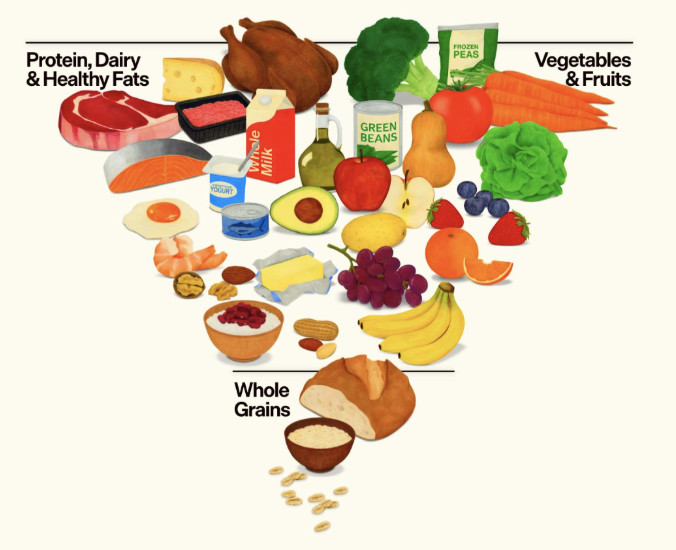
These new guidelines didn't land quietly; everyone on social media and beyond seems to have their thoughts about the food pyramid being flipped (literally) upside down. They're tougher on ultra-processed foods and added sugar than ever, and they make some major upgrades around protein and whole-food fat sources. In today's email, I'll tell you where I think they nailed it, where I'd push harder, and what the science actually says behind the headlines.
Protein
What the guidelines say
One of the biggest changes in the new Dietary Guidelines is a major upgrade in protein recommendations: 1.2–1.6 grams per kilogram of bodyweight per day (up from 0.8 g/kg/day). They also emphasize how you should hit that target by prioritizing high-quality, whole-food protein sources at every meal, from both animal and plant options. That includes eggs, poultry, seafood, dairy, and even red meat in moderation, as well as beans, lentils, nuts, seeds, and soy. They also make an important distinction about food quality, urging people to avoid deep-fried foods and choose meats with minimal added sugars, refined starches, and chemical additives.
My take
I’m fully on board with this protein upgrade. The old 0.8 g/kg/day recommendation was never intended to be an “optimal health” target, it was a deficiency-prevention floor. And in the real world, most people (especially older adults and athletes) do better with 1.2–1.6 g/kg/day for building and preserving muscle mass (when combined with resistance exercise), improving satiety, and supporting metabolic health. If anything, I’d make the recommendations even more practical:
- Distribute protein evenly across 2–3 meals.
- Protein needs rise with age. Older adults experience anabolic resistance, meaning it takes more protein per meal to trigger muscle protein synthesis, often ~30–40 grams per meal (vs. ~20–30 grams for younger adults).
- Prioritize protein quality and processing level. Most of your protein should come from whole foods with a strong amino acid profile, not protein powders (though they can be useful on occasion).
- Meat (including red meat in moderation) is not the issue. Processed meats are. They’re chemically different (nitrites, additives, often paired with refined carbs), and they don’t belong in the “health food” category. The guidelines quietly acknowledge this by urging people to choose meats with fewer additives and less refined junk.
Whole grains
What the guidelines say
The new guidelines don’t really debate "carbs” as a macronutrient. They zoom in on carb quality, specifically whole grains vs. refined grains, plus the broader theme of limiting highly processed carbohydrate foods. They recommend 2–4 servings per day of fiber-rich whole grains and explicitly urge people to significantly reduce refined grains, things like white bread, packaged breakfast foods, tortillas, crackers, and chips. Most of the carbohydrate calories in the U.S. diet come from low-quality, refined sources, and those are consistently linked with worse health outcomes. In contrast, higher whole-grain intake is associated with lower risk of all-cause mortality, cardiovascular disease, obesity, type 2 diabetes, and more.
My take
This shift from arguing about “carbs” to arguing about carb quality is one of the smartest changes in the new guidelines.
I think the whole grain recommendations should be viewed through the lens of fiber. Whole grains aren’t magical because they’re called “whole.” They’re useful because they’re typically a reliable vehicle for fiber, and fiber is one of the most under-consumed, high-impact nutrients in the modern diet. Most people should be aiming for at least 25–30 grams of fiber per day (and many would benefit from more) to support gut microbial diversity, improve satiety (which helps with body weight regulation), and lead to better cardiometabolic biomarkers and longevity. This is exactly why refined grains are such a problem: they're basically the structure of a grain with most of the benefits removed. They digest fast, spike glucose more aggressively, and provide very little satiety, functionally acting a lot like “sugar in disguise.”
And whole grains offer more than fiber. They come packaged with micronutrients (like magnesium and selenium) and bioactive compounds (e.g., ferulic acid in whole wheat or anthocyanins in black rice) that likely work synergistically. You don’t get that from refined flour that’s been stripped down and then “enriched” with a few nutrients.
Not everyone tolerates every grain. People with celiac disease or true gluten sensitivity obviously need a different strategy, and some people find certain grains trigger GI issues. In those cases, oats, quinoa, buckwheat, legumes, nuts/seeds, and vegetables can all cover the fiber gap.
(In Aliquot episode #140, along with Dr. Eran Elinav, I explore how gluten affects the gut barrier, who actually needs to avoid it, and the practical strategies that can help you build a more resilient gut).
Fruits & veggies
What the guidelines say
The guidelines keep fruits and vegetables front and center, no surprise there. The core message is to eat a variety of colorful, nutrient-dense produce in whole form. Frozen, canned, and dried options can absolutely count, as long as they aren’t loaded with added sugars. They also draw a clear line around juice: fruit and vegetable juices should be limited (or diluted), especially for kids, because juice is associated with weight gain in children. The general intake target is 3 servings of vegetables and 2 servings of fruit per day.
My take
I agree with the guidelines on juice, and I’d go one step further: for most people, fruit juice should be a "never food," especially for kids. Juice is basically liquid sugar. It's stripped of beneficial fiber and it delivers sugar fast with very little satiety.
But where I think the guidelines undershoot is enthusiasm. 3 servings of vegetables and 2 servings of fruit per day is a minimum. Fruits and vegetables are longevity foods. They’re our primary delivery system for fiber, potassium, magnesium, and an entire arsenal of bioactive compounds including vitamin C, beta-carotene, polyphenols, flavonols, and dozens of other phytochemicals that regulate oxidative stress and inflammation, two processes sitting right at the center of aging and chronic disease.
The evidence supports increasing fruit and vegetable intake as much as realistically possible, and some studies suggest the biggest risk reduction occurs around ~10 servings per day. Eat the spectrum: dark leafy greens, cruciferous vegetables, tomatoes, carrots and orange produce, mushrooms, and berries and other deeply colored fruits. Different colors represent different polyphenols and micronutrient profiles.
And no, I’m not afraid of fruit. Whole fruit comes packaged with fiber and polyphenols that blunt the glycemic response. The problem isn’t fruit, it’s what happens when you process the fruit into a sugar delivery system and throw the fiber away.
Added sugar (and the “fake sugar” problem)
What the guidelines say
This is one of the most aggressive, most scientifically defensible moves in the entire document. The guidelines state that “no amount of added sugars… is recommended or considered part of a healthy diet.” They also draw an especially important line for early life: children under 4 should consume zero added sugar. They even give a practical ceiling that no single meal should contain more than 10 grams of added sugar.
They specifically call out sugar-sweetened beverages, sodas, fruit drinks, and sugar-containing energy drinks as a key target. And in another striking shift, they recommend limiting low-calorie/non-nutritive sweeteners (like aspartame and sucralose), along with artificial flavors, petroleum-based dyes, and preservatives.
The guidelines also cite hard outcome associations for sugar-sweetened beverages. Higher intake is consistently linked with increased risk of type 2 diabetes (+39%), cardiovascular disease (+20%), obesity (+17%), depression (+25%), dental caries (+57%), and all-cause mortality (+10%).
My take
Added sugar is not a harmless indulgence. And if you want one “highest ROI” nutrition move that improves health across the board, it's to stop drinking sugar. Sugar-sweetened beverages are one of the cleanest levers you can pull because they deliver a concentrated glucose/fructose hit with almost no satiety, no fiber, and no meaningful nutrients.
Sugar also accelerates aging biology at the cellular level by driving the formation of advanced glycation end products (AGEs)—sticky molecular byproducts that damage proteins and tissues. It also pushes the brain in the direction of addictive-like reward signaling. There’s even evidence linking higher blood sugar—sometimes still within “prediabetic” ranges to structural brain changes, including in memory-related regions like the hippocampus.
Where the guidelines nailed it is the child-specific stance: zero added sugar under age 4. Early exposure to highly sweet foods trains a child's palate and reward circuitry to crave sweetness. That sets the stage for a lifelong pattern of ultra-processed foods, higher obesity risk, and metabolic dysfunction later in life.
The part I really love is the stance that replacing sugar with chemical sweeteners isn’t automatically a win. It’s not a free lunch. Yes, non-nutritive sweeteners reduce calories on paper, but emerging evidence suggests they can influence gut bacteria, appetite regulation, and glucose responses. Some sugar alcohols are now even raising red flags in cardiovascular/thrombosis research (this is evolving, but it’s enough to justify caution, especially with heavy, daily use). I’d rather see a “least bad” option like stevia or monkfruit than a daily habit of artificial sweetener cocktails, which I myself try to avoid.
(In Aliquot episode #66, Dr. Eran Elinav and I discuss some of the benefits, risks, and effects of sugar substitutes).
Fat
What the guidelines say
The new guidelines move away from treating saturated fat like the primary villain and instead emphasize fat quality and food context (i.e., fats that come packaged in whole foods: meat, eggs, omega-3–rich seafood, nuts and seeds, olives, avocados, and dairy). They explicitly state that full-fat dairy (milk, yogurt, cheese) can fit into a healthy diet without defaulting to skim only, and recommend about 3 servings of dairy per day, ideally without added sugar.
They also emphasize cooking fats like olive oil, and even include butter or beef tallow as options. At the same time, they retain the familiar guardrail that saturated fat should generally stay under ~10% of total calories, but they argue the evidence doesn’t support obsessively pushing it lower, or swapping it out for large amounts of linoleic-acid–rich refined oils as a universal heart-health strategy. They also note a “remarkable lack of evidence” that whole-fat dairy causes harm in adults or children, and warn that replacing whole-fat dairy with highly processed low-fat products may have had unintended metabolic consequences.
My take
I support the shift away from demonizing all saturated fat. The old framing was too simplistic, and it nudged people toward low-fat, high-sugar, ultra-processed “health foods” that made metabolic health worse, not better.
But this is not a license to mainline butter. Saturated fat is not a neutral nutrient for most people when it comes to cardiovascular biomarkers, especially LDL particles/ApoB, which are causal drivers of atherosclerosis.
The right way to interpret this update is to stop treating saturated fat as inherently toxic… but don’t pretend it’s irrelevant.
I want to highlight two important nuances here:
- Not all saturated fats behave the same. Stearic acid (common in cocoa butter and beef) tends to be relatively neutral on blood cholesterol, while palmitic and myristic acids (more prominent in butter, fatty meat, and palm oil) raise LDL more substantially. So “saturated fat” isn’t one thing biologically.
- The food matrix matters. Saturated fat eaten in the context of whole foods isn’t metabolically identical to saturated fat eaten in isolation. Cheese often raises LDL less than butter, possibly because cheese comes with calcium, protein, and a fermentation matrix that changes how it’s absorbed and metabolized. Fermented dairy and dark chocolate can look neutral or even favorable in some health outcomes despite containing saturated fat. That’s why I’m fine with full-fat yogurt and cheese in a nutrient-dense diet and why I’m not recommending anyone eat a stick of butter as a health hack.
Where I draw a hard line is the common internet overcorrection that saturated fat is a non-issue, and seed oils are poison, so feel free to eat unlimited butter. That’s not evidence-based, and it ignores individual lipid responses.
When it comes to my stance on fat:
- Make your base fats extra virgin olive oil, nuts, seeds, avocado, and omega-3–rich fish.
- Let saturated fat be present, not dominant.
- Avoid deep-fried, seed-oil–soaked ultra-processed foods.
- Remember that fat isn’t just “energy.” Many high-fat whole-food fats come packaged with fat-soluble vitamins (A, D, E, K), and dietary fat improves absorption of nutrients from vegetables, another reason real-food fats beat “fat-free” processed substitutes.
(In Q&A #68 (3/1/25), I discuss whether some saturated fats are worse than others for raising LDL)
Ultra-processed foods
What the guidelines say
For the first time ever, the guidelines come right out and say it: avoid highly processed packaged, prepared, ready-to-eat foods. They point out that ultra-processed foods have become a dominant calorie source in the U.S., making up nearly two-thirds of calories in the average American diet and cite the growing body of research linking ultra-processed food intake to worse health outcomes while also noting that randomized controlled trial data support a direct harmful effect of ultra-processed diets on key outcomes like calorie intake and weight gain.
Even more notable is that they explicitly flag chemical exposure pathways, meaning packaging and additives as a legitimate concern, and they endorse household strategies to reduce exposure from prepackaged foods.
My take
This is a hill I've been on for years. Ultra-processed foods aren’t just “empty calories.” They’re engineered matrices designed to be over-consumed. They're highly palatable, low-satiety, and typically built from a repeatable formula of added sugars, refined flours, industrial fats, salt, and a long list of additives… with very little fiber, very few micronutrients, and almost none of the phytochemicals found in real food.
And yes, the most convincing human evidence here isn’t just observational. The Kevin Hall NIH study I often cite is a perfect example: when people were given ultra-processed foods, they ate ~500 more calories per day and gained weight compared to when they ate unprocessed foods—even when the meals were matched for macros.
But the reason I treat ultra-processed foods as a primary prevention issue goes beyond calories and weight. UPFs can cause harm in more subtle ways that we’re still piecing together. Additives like emulsifiers disrupt the gut barrier, promote inflammation, and worsen glycemic control; artificial sweeteners in "sugar-free" products may alter gut bacteria and interfere with appetite and glucose regulation; and ultra-processed foods are a major vehicle for package-derived chemical exposure including plastic-derived compounds that end up in the food through processing and storage.
Ultra-processed foods should be rare in your diet. Not “every day but in moderation.” Rare. Your default diet should be home-prepared meals built from recognizable ingredients. It's THE main stance of the new guidelines: "Eat real food."
Omega-3s
What the guidelines say
The guidelines explicitly call out omega-3–rich seafood as a healthy fat source and note that Americans average only ~110 mg/day of EPA+DHA. They encourage choosing high-EPA/DHA, low-mercury seafood such as salmon, anchovies, sardines, oysters, and trout.
My take
This is an important inclusion in the guidelines because it points people toward preformed EPA/DHA rather than the fantasy that flax, chia, and walnuts reliably cover the gap (ALA conversion to DHA is inefficient and highly variable). Including the ~110 mg/day number is basically an admission that the population is underdosed.
Where I’d push back is that they still don’t give people a clear target. If we’re trying to move outcomes, “eat fish sometimes” isn’t enough. I’d rather see explicit goals like:
- a daily EPA+DHA target (often around ~1–1.5 grams/day for many adults, depending on goals), and/or
- a biomarker target like an omega-3 index of at least ~5% (often higher for some people).
Pregnancy & breastfeeding
What the guidelines say
The guidelines devote special attention to pregnancy and lactation and emphasize nutrient-dense eating patterns with key nutrients like folate, iron, iodine, choline, and DHA, plus continued nutrient support during breastfeeding.
My take
I’m aligned with the overall direction here, but I’d go above and beyond in emphasis on a short list of non-negotiables.
Folate: They recommend 400 µg/day for women of childbearing age and >600 µg/day during pregnancy to prevent neural tube defects. Folate is foundational for embryonic development. You can get it from leafy greens, legumes, avocados, and liver, but I still endorse a quality prenatal with methylfolate (the bioactive form).
Choline: Choline is mentioned, but it’s still not treated like it should be. Very few women hit ~450+ mg/day, many prenatals don’t contain meaningful choline, and many women aren’t eating eggs regularly. If folate is the famous pregnancy nutrient, choline is the unsung hero of fetal brain development. Egg yolks are the most efficient food source (~125 mg per yolk), and phosphatidylcholine supplementation can help close the gap. (And yes—there are studies suggesting higher choline intakes during pregnancy, even double the RDA, may support later cognitive outcomes in children).
Omega-3 DHA: The guidelines encourage 8–12 oz/week of low-mercury seafood during pregnancy, and I’m completely on board. DHA is literally a building block of the fetal brain. Prioritize oily, low-mercury fish like wild salmon, sardines, trout, and herring a few times per week. If someone doesn’t eat seafood consistently (and even if they do), I strongly recommend a prenatal DHA supplement—at least 200–300 mg/day, and often closer to 300–600 mg/day depending on baseline intake.
Iron: Iron requirements rise dramatically during pregnancy (by 50% or more). Iron supports maternal energy, prevents anemia, and builds fetal iron stores. Red meat is a concentrated source (and one the guidelines tend to push), but poultry, lentils, and spinach contribute too. And I’m pro-prenatal iron especially for women starting pregnancy with low ferritin.
Iodine: Iodine is mentioned, but I’d make it more explicit. The RDA is 150 µg/day, and iodine matters for fetal brain and thyroid development. Reliable sources include dairy, seafood, and iodized salt, but supplementing may be prudent if one’s intake of these items isn’t consistent.
Lactation
Breastfeeding extends the high-demand period. The guidelines emphasize continuing a nutrient-rich diet with B12, iodine, vitamin D, vitamin A, DHA, and choline, because mom is still the nutrient source for the baby. I strongly encourage continuing a prenatal vitamin during lactation, plus a whole-food diet built around protein-rich foods, folate-rich greens/legumes, eggs for choline, dairy for calcium, and omega-3 seafood. Protein and omega-3 intake can influence breast milk composition, and this is one of the clearest places where nutrition doesn’t just affect the mother; it shapes the infant.
(I talk in depth about strategies to optimize for a healthy pregnancy and early childhood in Aliquot episode #100).
Final thoughts
For the first time in a long time, these guidelines feel like they’re inching closer to biological reality.
The biggest win is the shift away from obsessing over single numbers while ignoring the food environment and toward the things that actually move outcomes: eat real food, dramatically reduce ultra-processed foods, stop drinking sugar, and prioritize protein and micronutrient density across the lifespan.
If Americans followed just those pillars, we’d see downstream effects everywhere. That means less obesity and type 2 diabetes, fewer cardiovascular events, better gut health, better brain health, and healthier aging.
But guidelines don’t change health, implementation does. Ultra-processed foods have become the default setting. They’re cheap, convenient, engineered for overconsumption, and aggressively marketed, especially to kids.
So while I’m encouraged by the stronger language in this report, the real test will be whether we pair it with policies and environments that make the healthy choice the easy choice. If so, I’m hopeful for the health of our nation.
Warm regards
— Rhonda and the FoundMyFitness team