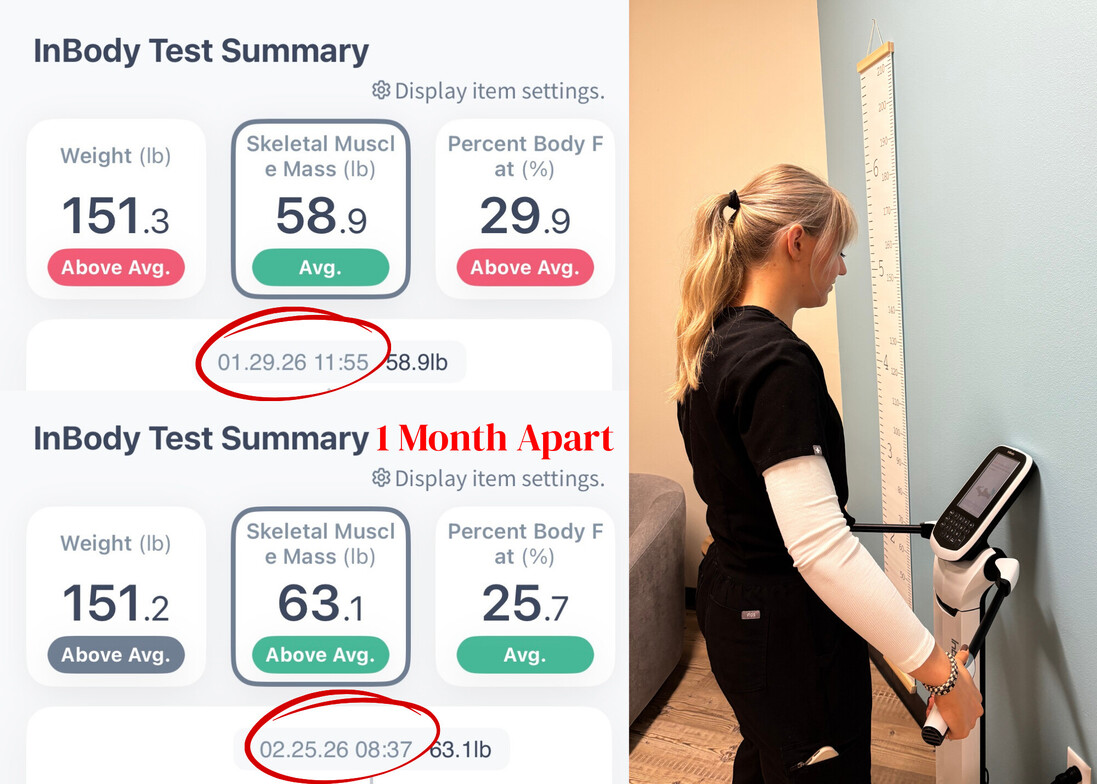
At our clinic, one of the most valuable tools we use—regardless of why you walk through our doors—is the InBody. Yes, even if you’re coming in for back pain. Yes, even if you’re dealing with headaches. And absolutely if you’re working through a functional or integrative medicine case. Because the truth is, your body composition tells a story far deeper than the number on the scale ever could. (Again, apologies for those who hate stepping on the scale, but this device is so great that when we embrace the data it provides, we can become 10x more individualized for your own goals.) The InBody is an exceptional tool that simplifies your providers understanding of your health and wellness.
When I look at an InBody scan, I’m not just looking at body fat. I’m looking at muscle balance between the right and left sides, upper versus lower body strength distribution, and total skeletal muscle mass, which is arguably one of our most important health markers. This becomes incredibly helpful even in chiropractic care. If someone has chronic pain or recurring injuries, asymmetries in muscle development often play a role. The InBody allows us to see those imbalances clearly and create a more targeted, effective plan. We also measure grip strength, which is one of the most underrated tools for identifying early sarcopenia, or muscle loss. Believe it or not, we’ve identified osteopenia in endurance runners under the age of 50—people who look healthy, people who are active, and people who would have never known otherwise. That’s the power of objective data. The even better news is that with the right interventions, we are seeing increased skeletal muscle mass, improved bone density markers, and reduced injury risk, often within 12 months.
One of the biggest shifts I try to help patients make is to stop focusing only on weight loss and start focusing on body fat loss and muscle gain. Skeletal muscle mass is protective. It is strongly correlated with better bone density, lower injury risk, improved metabolic health, and increased survivability and recovery from illness or trauma. No one has ever said, “I wish I had less muscle.” For our functional and integrative medicine patients, the InBody becomes even more powerful. Visceral fat, one of the biggest drivers of chronic disease, acts as fuel for metabolic diseases such as type II diabetes, obesity, heart disease, early cognitive decline, and certain cancers. These are conditions that are often preventable and even reversible with the right approach. Most patients come in having heard some version of “eat less and exercise more,” which, frankly, is largely unhelpful and half irritating.
The InBody allows us to go deeper by measuring resting metabolic rate, body fat versus muscle composition, and segmental muscle distribution. From there, we can give clear, personalized guidance on daily calorie needs and macro breakdown. Over 80% of the time, I’m actually encouraging patients to eat more food, and they are still losing body fat. This is because we are fueling their metabolism correctly, often correcting excess carbohydrate intake and insufficient protein intake. The body responds when it is supported properly. One of the exciting things right now is how technology is helping patients stay consistent. Apps like Cal AI make tracking macros fast, simple, and realistic, even for busy people.
While food and movement always come first, there are a few foundational supports I recommend often, especially here in the Midwest, including a high-quality multivitamin, omega-3s, vitamin D3 with K2, and a probiotic. I am also a big advocate for creatine for both men and women, especially over the age of 30. Creatine helps preserve and build muscle mass, improve recovery, and support cellular energy. If your goal is fat loss, maintaining muscle is critical. The older I get, the more clear this becomes: we must move. Movement is medicine. That does not mean you need to join an intense gym or train like an athlete, but it does mean daily movement, regular muscle loading, and intentional strength building over time. There are some cases where movement needs to be scaled back initially. Some patients come in highly inflamed, exhausted, and burned out. In those situations, we spend the first 6 to 8 weeks reducing the inflammatory burden before progressively reintroducing movement. That is the difference between a plan that works and one that backfires.
What I have observed over the past 14 months since implementing the InBody has been profound. I have seen patients lose over 80 pounds of body fat and gain over 20 pounds of skeletal muscle mass. More importantly, I have seen people gain clarity, confidence, and control over their health. This is not just about how you feel today. When we understand body composition, blood markers, and hormones, we are shaping your long-term health, your health span, and your quality of life. I have had 70-year-olds tell me they feel healthier now than they did in their 40s, and I have had parents bring in their 18 to 24-year-old children to establish a baseline in their prime. Many of these young adults do not have symptoms yet, but we can help them optimize and build healthy habits now before metabolic disease ever has a chance to set in. The InBody is not just a scan. It is a starting point for better decisions, personalized plans, and long-term change. When paired with the right support, education, and consistency, the results speak for themselves.
If April 14th @ 5pm fits your schedule, you should absolutely come to our Salad in a Jar Workshop—it’s going to be a fun one. You’ll get an InBody scan, prep six protein-packed salads to kick off your spring routine, and try a quick Emsculpt Neo arm session or Emsella Pelvic Floor Strengther session while you’re here.
Stay Well, cjk